
Events
Events & Courses
Featured 2024-2025 Events
Anscombe Unboxed on the Soul
September 16 | October 14 | November 18
 The Anscombe Reading Group is an opportunity for scholars, students, and interested readers to come together virtually three times during the Fall and three times during the Spring to discuss the philosophy of Elizabeth Anscombe, one of the seminal thinkers of the 20th century.
This Fall’s instantiation of the Anscombe Reading Group continues last year’s dive into the philosophical treasure trove that is the Collegium Institute Anscombe Archive, with a special focus on the subject of the soul. Across three sessions, we will read hand-picked selections from the Archive.
Faculty Colloquium: Beyond Excellence: On Contemplation and the Intellectual Life
November 14, 2025 | Cohen Hall, University of Pennsylvania
 This age-old question of the role of contemplation in the life of the mind has been made more relevant by our university-wide confrontation with AI: its awesome capabilities are leading us to imagine how we can “offload” tasks that once seemed core to the academic enterprise in the hopes of expanding our productivity exponentially… And if tasks like “brainstorming”, “outlining”, “writing”, and even “reading” now seem antiquated to many, what about the even more abstract exercise of contemplation, which by some historical accounts seemed to stand in for the academic project as a whole? Should we be re-articulating an account of education in which contemplation plays a significant role? Or is contemplation merely an epiphenomenon of other more concrete processes that now can be automated? This was an informal colloquium in which faculty across disciplines, schools, and other religious or ideological divisions build friendship through their engagement together of universal questions that are significant for our university community as a whole.
Staying Human in an Era of Artificial Intelligence: The Magi Project Fall Lecture
October 30, 2025 | Hall of Flags, Houston Hall, University of Pennsylvania

Our 21st century lives make it increasingly difficult to live as humans. From social media to Zoom meetings to fitness trackers, we live our lives in digital spaces, and in doing so, lose our grip on what is most real. Trends like these are not waning, but rather accelerating, spurred by AI and other new technologies. Most of these technologies are not intrinsically problematic and some can be used for good. Yet as our lives become increasingly digitized, the most human aspects of our lives atrophy. For the Catholic, moreover, since the sacraments meet us in our humanity, the patterns of 21st-century life threaten to undermine a sacramental outlook. In the Magi Project Fall Lecture, Professor Joseph M. Vukov, author of the recent book Staying Human in an Era of Artificial Intelligence, discussed his diagnosis of our current situation, and issued a call to action to resist problematic trends in it. Professor Vukov is an Associate Professor of Philosophy Department and the Associate Director of the Hank Center for the Catholic Intellectual Heritage at Loyola University Chicago. He serves on the AI Research Group for the Dicastery for Culture and Education and is the current President of Philosophers in Jesuit Education.
Class Matters: A Spirited Debate event on the Demise of Affirmative Action and the Demand to Build “Real Diversity” in Higher Education
October 8, 2025 | Princeton University

Director of the American Identity Project at the Progressive Policy Institute, Richard Kahlenberg provided groundbreaking testimony that played a pivotal role in persuading the Supreme Court to strike down racial affirmative action, dismaying – and outraging – his own progressive circle. Yet, his conviction that economic disadvantage provides a better, more fair way to achieve diversity is unwavering. In his new book, Class Matters: The Fight to Get Beyond Race Preferences, Reduce Inequality, and Build Real Diversity at America’s Colleges, Professor Kahlenberg made the definitive case for adopting a class-based approach to college admissions, giving more people a place at the table and more opportunity to “swim in the river of power.” He included an analysis of the preliminary admission results following the Supreme Court’s ruling, which indicate that colleges can achieve racial and economic diversity without explicit racial preferences. Professor Kahlenberg presented the case of Class Matters at this special event of Princeton University’s James Madison Program, co-presented with the new Spirited Debate Initiative of the University of Pennsylvania’s Program for Research on Religion and Urban Civil Society (PRRUCS). Kahlenberg’s opening remarks were followed by comments from Professor Marta Tienda (Princeton University) and Professor John McWhorter (Columbia University and New York Times). The conversation was moderated by Professor Robert P. George, Faculty Director of the James Madison Program.
ISME 2025: Intellectual Traditions in Dialogue and Conflict
July 10-12, 2024 | The Arch, University of Pennsylvania

In this first annual meeting of the International Society for MacIntyrean Enquiry (ISME) since the passing of Alasdair MacIntyre, this 3-day conference aimed to explore MacIntyre’s rich conceptualization of tradition and tradition-constituted enquiry, inviting discussions on the diverse interactions, conflicts, and potential reconciliations between various intellectual paradigms. Special attention was paid to how the contemporary moral philosophy and (and contemporary moral challenges) relate to classical virtue ethics, an ethical tradition reclaimed in the 20th century by MacIntyre and Elizabeth Anscombe, whose archive is held in Penn Special Collections through a partnership with PRRUCS.
Faculty Colloquium, “Rebuilding Trust in Higher Ed: Reawakening Socrates?”
April 25, 2025 | Penn Graduate School of Education

Last spring two Penn faculty members, Ezekiel Emanuel (Med) and Harun Küçük (Hist & Soc of Science), co-authored a New York Times Op-Ed, “Higher Education needs more Socrates and Plato.” Here is how it begins:
“The right attacks colleges and universities as leftist and woke. Progressives castigate them as perpetuating patriarchy and white privilege. The burdens of these culture war assaults are compounded by parents worried that the exorbitant costs of higher education aren’t worth it. No wonder Americans’ faith in universities is at a low. Only 36% of Americans have confidence in higher education…”
How in the world could Socrates be a plausible solution to this crisis in trust? And even if he somehow were, how might a remedy in that philosopher’s name correspond to the path of study outside the Humanities — to the natural sciences and the professional schools? Moreover, the university context in spring 2024 appears very different than the one in spring 2025: to what extent might last year’s suggestions for strengthening the university remain relevant?
This informal colloquium convened a diverse group of scholars to reflect on the current relevance and practicality of “reasserting the liberal arts idea” proposed by the NYT essay co-authors.
The Abnormal Becomes Normal: Facing Human Suffering in Clinical Medicine
April 9, 2025 | Amado Recital Hall, Irvine Auditorium, University of Pennsylvania
 Collegium Institute and PRRUCS presented a Medical Humanities Special Event with Naomi Rosenberg, MD, the Assistant Dean for Narrative Medicine and Health Humanities and an Emergency Medicine physician at the Lewis Katz School of Medicine at Temple University, who delivered a lecture and workshop on the importance of learning to understand and tell stories about the ways patients, families, and healthcare workers face human suffering in clinical practice.
Anscombe Unboxed on Bioethics
February 5 | March 5 | April 2

The Anscombe Reading Group is an opportunity for scholars, students, and interested readers to come together virtually three times during the Fall and three times during the Spring to discuss the philosophy of Elizabeth Anscombe, one of the seminal thinkers of the 20th century.
This Spring’s instantiation of the Anscombe Reading Group continues last year’s dive into the philosophical treasure trove that is the Collegium Institute Anscombe Archive, with a special focus on the subject of bioethics. Across three sessions, we will read hand-picked selections from the Archive.
All-American Socrates: The Intellectual Legacy and Teachings of Dr. Michael Sugrue
Monday, February 3, 2025 | Ave Maria University

What does Socrates have to teach the American University today? To address this question, Penn PRRUCS Faculty Director John J. DiIulio, Jr., considered the life and legacy of Michael Sugrue, one year after his death in January 2024. Like Socrates, Sugrue was largely “unpublished”, but he devoted his career to teaching the philosophical wisdom and historical traditions of the last three millennia to generations of students at the University of Chicago, Columbia, Princeton, and Ave Maria University. He also was among the most popular and celebrated lecturers of The Teaching Company’s Great Courses series and became, according to the New York Times, an “internet phenomenon” for both his teaching videos and his podcasts. Could there be a future for “The Great Teacher” of “the great minds” in the contemporary research university and beyond?
The Sun Rises in the East: Missionaries in East Asia
Friday, January 31, 2025 | Penn Newman Center

Professor Stephanie Wong (Villanova; PRRUCS Senior Affiliate) joined us for “The Sun Rises in the East: Evangelization in East Asia” in a seminar discussion on missionaries in East Asia. We examined the history of Christian evangelization in mainly China, including the cultural and state tensions and different missionary approaches from Catholics and Protestants. We investigated the immediate and long-term consequences of various evangelization approaches, especially focusing on translations (i.e. Matteo Ricci’s integration of Confucian thought in his translations of Western philosophical texts).
Is There a Catholic Case for a Second New Deal?
Wednesday, January 22, 2025 | University of Pennsylvania

The University of Pennsylvania’s Program for Research on Religion and Urban Civil Society (PRRUCS) presented a “Spirited Debate” symposium on Wednesday, January 22, 2025, at the Penn Club of New York (30 W 44th St). The program began with a reception for all guests at 5:30 pm and a symposium from 6:30 – 8:30 pm.
Prof. John J. DiIulio, Faculty Director of PRRUCS, delivered the opening address: “South Philly Elegy: The Catholic Case for a Second New Deal.” The featured commentators included Sohrab Ahmari of UnHerd, Dr. E.J. Dionne of the Brookings Institution, and former US Senator Rick Santorum.
PRRUCS hosted this “Spirited Debate” symposium through its Perry-Collegium Initiative and it became the first part of a series on “Catholicism, Liberalism, and the Future of Democracy.” This event was co-sponsored by First Things and America Media.
It's Not About the Laughs: Improving Health Equity Through Medical Improv
Thursday, November 21, 2024 | University of Pennsylvania

For health equity, transformation happens as students share their perspectives of curriculum content from their own identities and experiences. It happens when they are challenged by others’ perspectives and attempt to understand how others can experience the same content differently. The arts can create a powerful form of sharing beyond routine conversations or discussions, which is critical for honest dialogue on difficult topics concerning race and identity.
The Collegium Institute and PRRUCS presented a Medical Humanities Special Event with Dr. Marshall Chin of the University of Chicago, who delivered a lecture on improving health equity through medical improv. He has in the past incorporated improv workshops into the first year curriculum at UChicago. He then proceeded with a 1-hour workshop with everyone.
Marshall H. Chin, M.D., M.P.H., Richard Parrillo Family Distinguished Service Professor of Healthcare Ethics at the University of Chicago, is a practicing general internist and health services researcher who has dedicated his career to advancing health equity through interventions at individual, organizational, community, and policy levels. Through the Robert Wood Johnson Foundation Advancing Health Equity: Leading Care, Payment, and Systems Transformation program, Dr. Chin collaborates with teams of state Medicaid agencies, Medicaid managed care organizations, frontline healthcare delivery organizations, and community-based organizations to implement payment reforms to support and incentivize care transformations that advance health equity within an anti-racist framework. He also co-chairs the Centers for Medicare & Medicaid Services Health Care Payment Learning and Action Network Health Equity Advisory Team.
This event is co-sponsored by the Health Humanities & Medical Arts Program at Villanova University and the John Templeton Foundation’s In Lumine Network Grant.
Civil Disobedience? On Law and the Common Good
Monday, October 21, 2024 | University of Pennsylvania

The virtue of Civil Disobedience is justly celebrated today. But what about the opposite: when and why must we follow the law? Penn’s Perry-Collegium Initiative presents a Legal Humanities Special Event that will examine a newly-published book by Professor Daniel Mark of Villanova University about the source of our obligation to be law-abiding citizens.
Professor Mark offered remarks on his 2024 book The Nature of Law: Authority, Obligation, and the Common Good, in which he argues that our responsibility to the law originates in the fact that it is a set of commands oriented towards the common good. Professor Mark defines legal obligation as fundamentally related to moral obligation and religious obligation more broadly.
Professor Daniel Mark is an Associate Professor of Political Science at Villanova University and former Chairman of the United States Commission on International Religious Freedom. His remarks were followed with comments from Prof. Amy Sepinwall (University of Pennsylvania) and Dr. Evelyn Boyden (Princeton University).
The Civically Engaged Professor - Faculty Colloquium
Friday, September 17, 2024 | Silverstein Forum at the Penn Graduate School of Education

The event was a Faculty Colloquium organized around the theme of “The Civically Engaged Professor.” The participants represented a diverse cross-section of Penn faculty, including representatives from the School of Nursing, the Graduate School of Education, and the School of Arts & Sciences, as well as a number of distinct academic departments. The event sought to explore questions such as:
● What is the role of faculty in the civic formation of students? What role should civic-mindedness play in a faculty member’s understanding of their own work?
● How should faculty think both constructively and critically about the entry of their own politics and civic commitments into the classroom?
● What is the relationship between the role of civics in the classroom and the role of education more broadly?
● What, if any, are the unique civic responsibilities of faculty members teaching in the city of
Philadelphia and the state of Pennsylvania? What is Penn’s role in fostering local civic engagement and identity?
The event was organized around two main sessions, which each lasted approximately one (1) hour. The first, facilitated by Dr. Lia F. Howard (SNF Paideia Program), began with a presentation of Dr. Howard’s work with the Political Empathy Lab at Penn. Dr. Howard shared her experience of traveling across the state of Pennsylvania with a group of student research assistants to engage in “political listening” throughout Summer 2024. Participants
discussed pathways for mobilizing empathetic civic engagement with students, both inside and outside the classroom. The second session was facilitated by Prof. H. Gerald Campano (GSE). In the discussion, participants reflected on the role that their own civic commitment plays in their pedagogy, with many citing specific examples of issues in their classrooms that have shifted over the last few years.
Anscombe Unboxed on Natural Theology
September 18 | October 16 | November 20

The Anscombe Reading Group is an opportunity for scholars, students, and interested readers to come together virtually three times during the Fall and three times during the Spring to discuss the philosophy of Elizabeth Anscombe, one of the seminal thinkers of the 20th century.
This Fall’s instantiation of the Anscombe Reading Group continues last year’s dive into the philosophical treasure trove that is the Collegium Institute Anscombe Archive, with a special focus on the subject of natural theology. Across three sessions, we will read hand-picked selections from the Archive.
This was another exciting chance to engage Anscombe’s thought in a unique and open setting.
The Myth of Religious Violence? A 15 year Retrospective with Professor William Cavanaugh
Thursday, April 25th, 2024 | Penn Hillel Center

In 2009 the landmark monograph of William Cavanaugh, The Myth of Religious Violence: Secular Ideology and the Roots of Modern Conflict, was published by Oxford University Press. In that work, Cavanaugh showed how the term “religious violence” is not just an uncomplicated description of tragic phenomena witnessed all too frequently around the world. On the contrary, he argued, it is a foundational myth of western societies that denigrate religious actors as irrational and their conflicts as intractable while at the same time concealing and legitimating state violence against those same actors.
Now in 2024, fifteen years later, it seems that many of the global conflicts – certainly in Ukraine and the Middle East as well as elsewhere in Africa, Asia, Latin America, and the US itself – which have embroiled college campuses and played a role in toppling their presidents, have involved unmistakable religious elements. So how then are we to understand them if not by religious violence? Is “religious extremism” any better or do alternatives like those mobilize new threats against religious liberty? And how might it become possible not only to understand religious communities and their traditions as not primarily responsible for global violence but also to activate them as vital sources of healing and reconciliation?
Costs of Climate Change: A Magi Project Conversation
Monday, April 15th, 2024 | Penn Newman Center

As the world economy transitions to net-zero emissions, the economics of climate change offers important insights into key policy choices: How should we ensure this transition is efficient? How do we distribute its costs within society? How do we incentivize technological progress in climate adaptation and mitigation? What are the challenges for the transition created by geo-strategic fragmentation?
Our panelists explored these significant questions, from a range of perspectives, drawing together their academic expertise and their own faith perspectives, particularly in light of the recent apostolic exhortation, Laudate Deum.
This was a Perry-Collegium Event evening conversation with Prof. Allison Covey (Ethics, Villanova University), Prof. Christina Parajon Skinner (Legal Studies and Business Ethics, University of Pennsylvania), and Prof. Jesús Fernández-Villaverde (Economics, University of Pennsylvania).
Anscombe, Intention, and Cooperation with Evil
Friday, April 12th, 2024 | Penn Newman Center
 This year’s annual Anscombe Lecture, “Anscombe, Intention, and Cooperation with Evil,” will be given by Fr. Kevin Flannery, S.J. (Pontifical Gregorian University) on Friday, April 12 at 7pm in the lower lounge of the Penn Newman Center (111 S 38th Street).
Anscombe Unboxed: Reading the Anscombe Archive
February 8 | March 5 | April 9
Art & Truth: Exploring the Responsibility of the Artist
Monday, March 11th, 2024 | Penn Newman Center
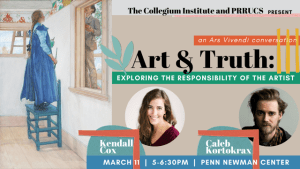 Join PRRUCS and Collegium Institute’s Ars Vivendi Project for this evening conversation with Kendall Cox, Director of Academic Affairs for the Templeton Honors College, Professor, and artist, and painter Caleb Kortokrax.
“Making Sacred All the Whispers of the World”: The Cabaretesque and the Aesthetics of Trauma
Tuesday, February 20, 2024 | Rose Recital Hall
 Trauma—as memory, as history, as past, as present—is inseparable from the sound and music of Jewish life. Sounding such trauma, giving voice to pain and tragedy, is possible only upon confronting the aesthetic paradox of how beauty, meaning, and agency intersect with the reality of trauma. Drawing upon Philip Bohlman’s decades-long engagement with the performance and study of Jewish music on the cabaret stage, especially with his ensemble, the New Budapest Orpheum Society, the 27th annual Meyerhoff Lecture explores the paths that lead beyond the paradox, even in the moments of greatest trauma.
Established in 1996, the annual Joseph and Rebecca Meyerhoff Lecture honors the memory of Joseph and Rebecca Meyerhoff, parents of Eleanor Meyerhoff Katz, wife of Herbert D. Katz, and important philanthropists who supported numerous and enduring civic and Jewish causes. The series brings to Penn preeminent scholars for a campus talk meant to enrich the experience of Katz Center fellows and open up the fellowship theme to the broader university community.
This event was cosponsored by the PRRUCS Perry-Collegium Initiative.
Spirited Debate Courses
Spirited Debate First Year Seminars are premised on two core academic principles that must be held together: (1) truth matters and (2) community matters. These seminars offer first year students the opportunity to contribute to both of these university pillars. Spirited Debate seminars are “spirited” in at least two ways: First, they are designed to cultivate vigorous yet civil and constructive debate on topics that often spark intense disagreement. And second, they make a point neither to exclude religious traditions from inquiry nor to marginalize religious argumentation. Instead these courses invite serious engagement with all influential intellectual traditions in order to evaluate the common questions of our humanity within the diverse, interdisciplinary community that our university welcomes.
HIST 0065: Histories of Religion and Violence
 Can religious fervor coexist with good citizenship? The American political project was designed, according to many of its original activists as well as contemporary theorists across the political spectrum, both to establish a safe haven for free religious practice and at the same time to protect the public from religious violence. But has it ever been possible to advance both goals together, or does one always swallow the other? As we approach the 250th anniversary of the United States, this Spirited Debate course welcomes first year students to re-examine the different stories about religion and violence that have structured our modern politics. While this class will prioritize the exploration of accounts of medieval and early modern religious violence that were pivotal to highly influential frameworks for American democratic government (like inquisitions, crusades, and the Wars of Religion), it will also consider both more ancient and more contemporary histories, such as religious origin stories, 19th century histories of “the warfare between religion and science”, and 20th century accounts of religious terror as well as totalitarian violence against religious communities. It will also lead students to reflect both critically and constructively about fundamental theories of religion and violence as they engage in an interdisciplinary and collaborative investigation of primary sources and artifacts, sacred texts, influential histories, and contemporary controversies. In the process, students will develop vital capacities for civic engagement within our religiously (and non-religiously) pluralistic polity.
HIST 0066: The Scriptures in World History
 How do books shape history? How does history re-shape books? This seminar examines how the sacred texts of Jewish and Christian religious traditions have been compiled, authorized, represented, manufactured, adjusted, restricted, rejected, reproduced, and consumed from the Dead Sea Scrolls to the Smart Phone. It will study how revelation was textualized through a variety of media (e.g., papyrus roll, stone monument, manuscript codex, printed broadside, ritualized speech, digital screen) in order to uncover its historical functions: under what circumstances were the scriptures used to fortify institutional authority? To ignite revolutions? To create communities? To marginalize others? How do all these functions relate to fundamental beliefs in sacred scripture as divinely-revealed truth? These are hotly contested questions among scholars as well as the general public, and in this Spirited Debate First Year Seminar students will be invited both to analyze and engage in these debates. The following historical contexts will be subjected to closer review: the struggle to determine what counted as Scriptures in the Mediterranean world of antiquity; the birth of university culture in the medieval world alongside popular piety and entertainment; Reformation and Counter-Reformation dialectics; humanism and censorship; radical modes of non-textual prophetic illumination; early modern skepticism and rationalism; global missionary projects and local resistance; critical method, ecumenism, and fundamentalism.
PSCI 0010-302: The Open Mind: Debating Freedom of Speech
 What is freedom of speech? What are its foundations? What gives freedom of speech its significance and value? To what extent (if any!), under what conditions (if any!), and in what context (if any!) should we regulate, marginalize, limit, stigmatize, or violate freedom of speech for the sake of other principles or concerns? In this course, we will ponder and debate these and other questions in conversation with thinkers, scholars, and pundits from across the centuries and our own present time. Using the central chapters of John Stuart Mill’s seminal essay On Liberty as our philosophical touchstone, we will venture into a variety of topical areas. For example, has Mill’s “trident” been blunted by the age of misinformation? Is it absurd or dangerous to tolerate intolerance? Is “reasonable” speech difficult or impossible to reconcile with certain religious beliefs and tenets? How should freedom of speech be tailored to places with core missions, like college campuses? How can freedom of speech survive in arenas where chaos reigns, like social media? The goal of this course is to cultivate and encourage in students a deep awareness of and nuanced appreciation for what makes freedom of speech not only important and meaningful but also difficult and provocative.
Sample of other PRRUCS – Co-Sponsored Courses
AMES 335 Muslim, Christian, and Jewish Relations in the Middle East
ASTR 007 The Big Bang and Beyond
COML 200 Mythology
ENGL 359 Belief in the Age of the Enlightened Cosmopolite
FOLK 025 Magic, Science, and Religion
HIST 201 Tolerance, Then and Now
HIST 201.601 Scriptures in World History
HIST 234 The Catholic World: Medieval to Modern
HIST 313 Religion and Society in the Iberian World
HIST 325 Religion in American History
HIST 415 Seventeenth Century Intellectual History: Origins of Modernity
HSSC 001 The Emergence of Modern Science
HSSC 301 Science and Religion
LEAD 400 Global Leadership and Problem Solving
MUSC 150 Introduction to Global Music/ Thinking Globally about Music
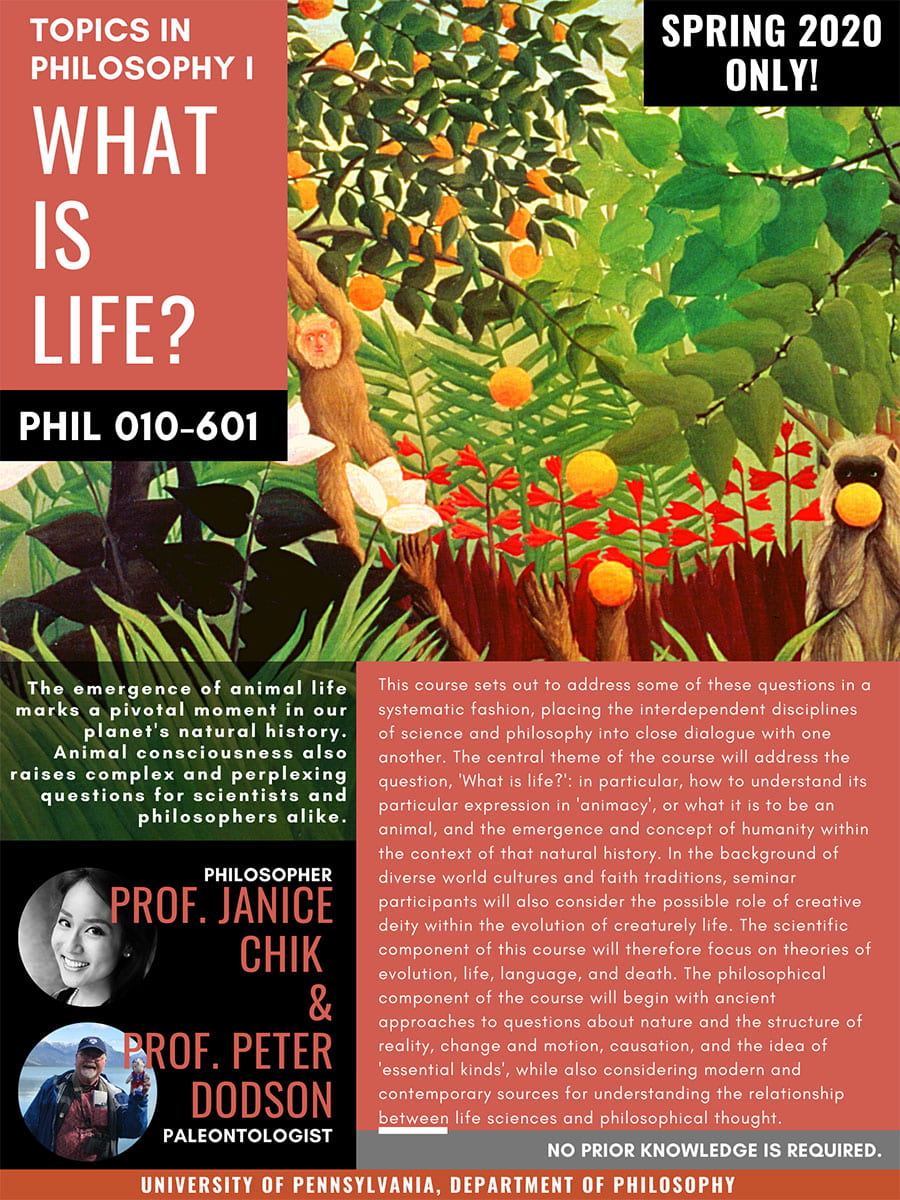
PHIL 010 What is Life? A Philosophical and Scientific Exploration of Nature
PSCI 240 Religion and Public Policy
PSCI 275 Muslim Political Thought
PSCI 298 Spirited Debate
RELS 002 Religions in the West: Judaism, Christianity, Islam
RELS 107 Religion in Philadelphia
RELS 010 Religion in Public Life
RELS 111 Religion and Secular Values: Hip Hop Culture
RELS 133 Introduction to Christianity
RELS 144 Persian Mystical Thought: Rumi/ The Foundations of Islamic Mysticism
SAST 163 Introduction to Hinduism
SOCI 300 Religious Life at Penn
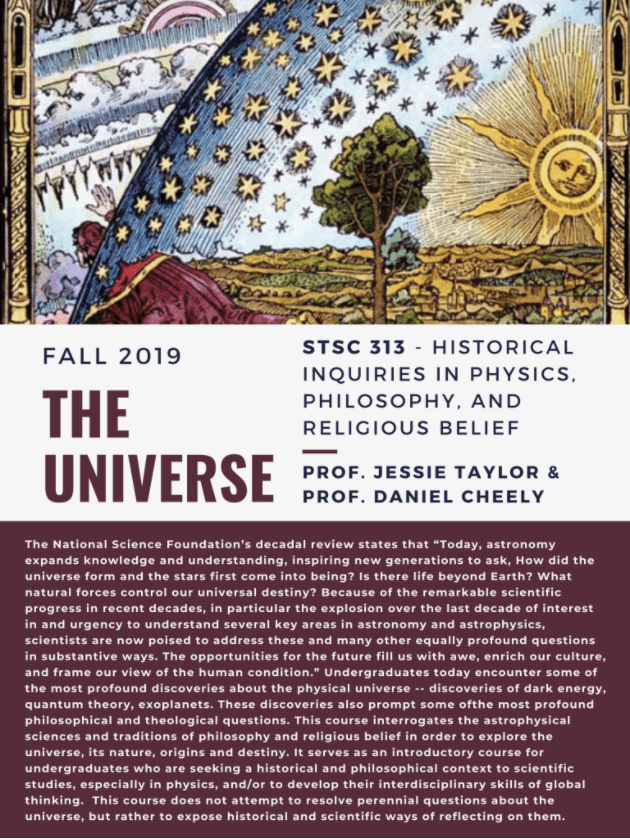
STSC 313 The Universe: Historical Inquiries in Physics, Philosophy, and Religious Belief

In addition to these special events and for-credit courses, PRRUCS also supports a variety of programs for University of Pennsylvania students through the PRRUCS-Collegium Initiative, including Food for Thought, Faith & Reason, Medical Humanities Fellowship, Philosophy of Finance Fellowship, Legal Humanities Fellowship, and more.